
Počeci i otvaranje hotelaOrigins and opening
Grad na razmeđiA city at the crossroads
1540–1882
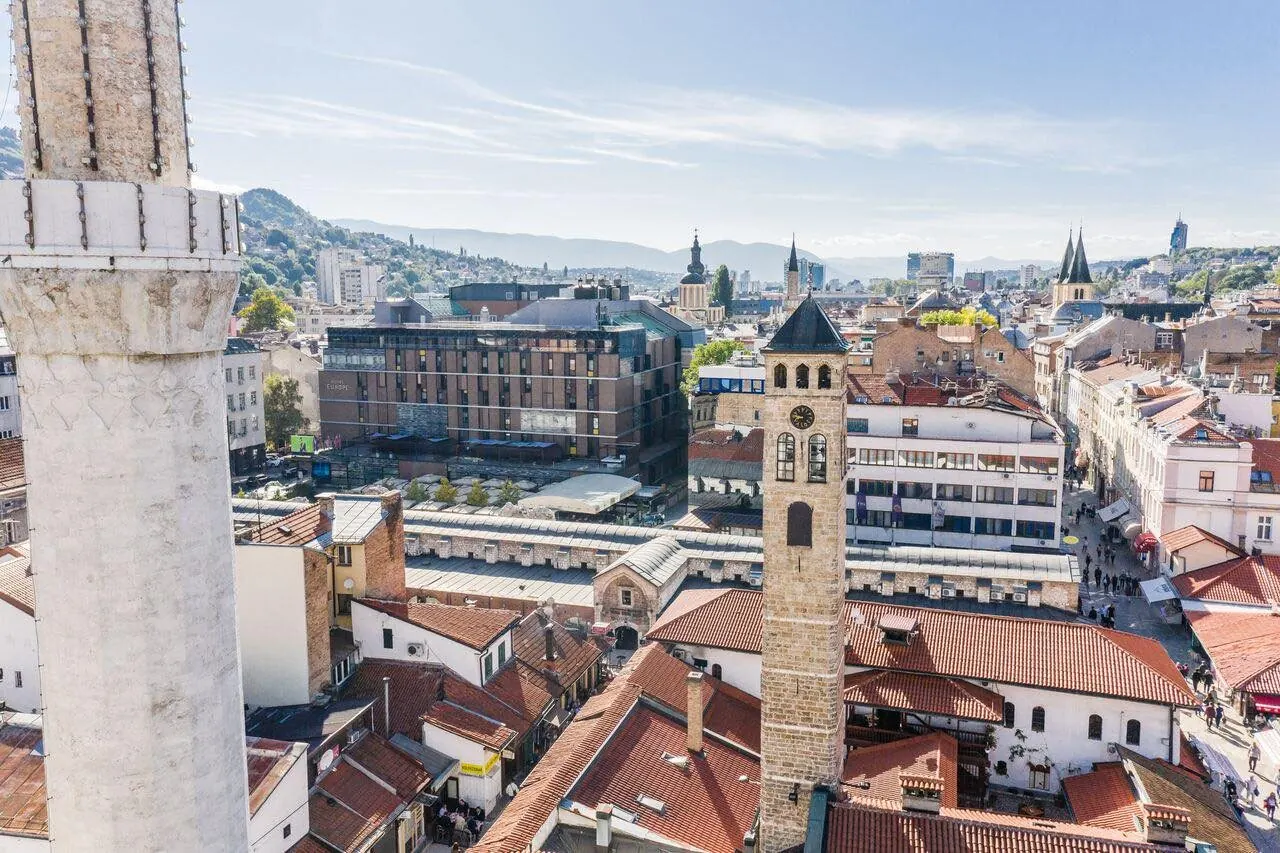
Današnji pogled na Baščaršiju i austrougarski dio grada s munare Gazi Husrev-begove džamijeBaščaršija and the Austro-Hungarian city today, seen from the minaret of the Gazi Husrev-beg Mosque
Prije hotela bio je han, a prije hana karavanski put. Ova priča počinje na mjestu gdje su Sarajlije stoljećima dočekivale putnike.Before the hotel there was an inn, and before the inn a caravan road. This story begins at the place where, for centuries, Sarajevo learned to welcome strangers.
Kada je Gazi Husrev-beg, najveći graditelj osmanskog Sarajeva, podizao svoj bezistan, uz njegov zapadni zid niknuo je i kameni han. Tašlihan, „kameni han“, sagrađen je između 1540. i 1543. godine kao dio begovog vakufa. Godine 1542. za gradnju hana tražili su se majstori iz Dubrovnika. Han je bio gotovo kvadratne osnove. U dvorištu je stajala česma, a iznad nje mala džamija na stubovima. U prizemlju su bile magaze, štale i dućani, a na spratu sobe pod kupolama, u kojima su noćili trgovci s karavanama.
When Gazi Husrev-beg, the greatest builder of Ottoman Sarajevo, raised his covered bazaar, a stone inn rose against its western wall. The Tašlihan, the “stone inn”, was built between 1540 and 1543 as part of the bey’s endowment. In 1542 master builders were requested from Dubrovnik for the work. The inn was almost square in plan, with a courtyard holding a fountain and, above it, a small mosque raised on columns. On the ground floor were storerooms, stables and shops; upstairs were domed rooms where merchants travelling with caravans spent the night.
Sarajevo je imalo tri velika karavan-saraja: Tašlihan, Morića han i Kolobara han. U njima su se spajali putevi iz Dubrovnika, Carigrada i Beograda, a s robom su stizale i vijesti, jezici i navike. Dočekivanje putnika bilo je dio života u Sarajevu mnogo prije nego što je u njemu niknuo prvi hotel.
The Tašlihan was one of Sarajevo’s three great caravanserais, along with Morića Han and Kolobara Han. In them the roads from Dubrovnik, Constantinople and Belgrade met, and with the goods came news, languages and habits. Welcoming strangers was a craft in this city long before its first hotel was built.
I tri stoljeća kasnije put do sarajevskog Bezistana još se mjerio danima hoda. S uspostavom austrougarske uprave 1878. godine u Bosnu su počeli pristizati činovnici, oficiri, inženjeri i trgovci iz cijele Monarhije. Ti su putnici u Sarajevu tražili drugačiji smještaj: sobu s krevetom, kupatilo, restoran s jelovnikom i kafanu s novinama na nekoliko jezika.
Three centuries later, the street around the Bezistan was still a place where arrivals and departures were measured in days on the road. Then, in 1878, Bosnia came under Austro-Hungarian administration, and with it came officials, officers, engineers and merchants from across the Monarchy. Suddenly the city needed a different kind of lodging: a room with a bed, a bathroom, a restaurant with a menu, and a café with newspapers in several languages.
Prvi koji je to shvatio bio je Eduard Lasslauer, doseljenik iz Monarhije. Iste 1878. godine preuzeo je Jelića han, koji je stajao na mjestu današnjeg hotela, i preuredio ga. Trideset pet godina kasnije list Bosnische Post pripisao je Lasslaueru zaslugu za uvođenje evropskog načina hotelijerstva u Bosnu i Hercegovinu.
The first to grasp this was Eduard Lasslauer, a newcomer from the Monarchy. In that same year, 1878, he took over the Jelić inn, which stood on the site of today’s hotel, and refitted it. Thirty-five years later the Bosnische Post credited Lasslauer with introducing European-style hotels to Bosnia and Herzegovina.
Tabla IPlate I
Kameni hanThe stone inn
Ono što je zemlja sačuvalaWhat the earth kept
Arheolog M. Gavrilović vodio je prva zaštitna istraživanja Tašlihana od 8. juna do 13. jula 1998. godine. Istraživanja su obuhvatila istočni plato hotelske bašte uz obnovljeni zapadni zid Bezistana. Na istraženoj površini od deset puta trideset metara arheolozi su otkrili zid dug dvadeset dva metra koji se pružao uporedo s Bezistanom. Građen je od lomljenog krečnjaka složenog u pravilne redove visoke oko petnaest centimetara. U temeljima su se nalazila dva paralelna kanala za provjetravanje, a podovi su bili od opeke, kamenih ploča i kaldrme.
The first rescue excavation of the Tašlihan ran from 8 June to 13 July 1998, directed by the archaeologist M. Gavrilović, on the eastern terrace of the hotel garden beside the rebuilt west wall of the Bezistan. Across an area of ten by thirty metres a wall twenty-two metres long came to light, parallel to the Bezistan: rough limestone laid in regular courses about fifteen centimetres high. The foundations held two parallel ventilation channels, and the floors were of brick, stone slabs and cobbles.
O svakodnevnom životu u hanu svjedoče glazirane pločice, porculanski tanjiri, prozorsko staklo, bronzani okovi, željezni ključevi i petnaest glinenih lula. Među najstarijim nalazima izdvajaju se novčići iz vremena cara Maksimilijana II, iz razdoblja od 1564. do 1576. godine. Neposredno iznad kaldrme ležala su tri novčića iz 1882. godine, kada je Evropa otvorila vrata.
The finds tell of the inn’s daily life: glazed tiles, porcelain plates, window glass, bronze fittings, iron keys and fifteen clay pipes. Among the oldest finds are coins of Emperor Maximilian II, from 1564–1576. And immediately above the cobbles lay three coins from 1882, the year the Evropa opened.
Han ispod hotelaThe inn beneath the hotel
U nastavku istraživanja Muzeja Sarajeva, od 9. do 21. jula 2007. godine, arheolozi Mirsad Avdić i Adnan Muftarević zaključili su da se han prostirao ispod poslijeratnog krila i dijela stare hotelske zgrade. Tašlihan je gorio još 1697. godine, a uništen je u požaru 1879. godine.
The Museum of Sarajevo resumed work from 9 to 21 July 2007, with the archaeologists Mirsad Avdić and Adnan Muftarević, and concluded that the inn had extended beneath the post-war wing and even under part of the old hotel building. The Tašlihan, after all, had burned before, in 1697, long before the fire of 1879 destroyed it.
Tokom gradnje podzemne garaže radnici su rastavili temelje hana i ponovo ih postavili na garažnu ploču. Tu ih posjetioci danas mogu vidjeti. Komisija za očuvanje nacionalnih spomenika izmijenila je 2016. godine mjere zaštite ostataka Tašlihana, ocijenivši da su njihova autentičnost i integritet postali vrlo upitni. U saopćenju od 27. jula 2017. pojasnila je da ukidanje statusa nacionalnog spomenika nikada nije razmatrala. O načinu na koji se postupalo s ostacima kritički su pisali Stav i Radio Slobodna Evropa. I danas ostaje otvoreno pitanje kako te ostatke dostojno predstaviti javnosti.
The remains guests see in the garden today have not stayed untouched: when the hotel’s underground garage was built, the foundations were dismantled and laid again on its roof slab. In 2016 the Commission to Preserve National Monuments revised the measures protecting the remains of the Tašlihan, judging their authenticity and integrity highly questionable. In a statement of 27 July 2017 it clarified that it had never considered revoking the site’s national-monument designation. The treatment of the remains was criticised by Stav and Radio Free Europe. How best to present the remains is still an open question.
Tabla IXPlate IX
Tri novčića iz 1882.Three coins from 1882
Plamen u augustuFire in August
Taj prvi hotel nije dugo opstao. U augustu 1879. Sarajevo je zahvatio jedan od najtežih požara u historiji grada. Vatra je progutala veliki dio čaršije. Stradao je i Tašlihan, koji poslije toga nikada nije obnovljen, a s njim i Lasslauerov han.
That first hotel did not last long. In August 1879 a great fire swept through Sarajevo, one of the worst in its history, consuming much of the bazaar. The Tašlihan was ruined too and never rebuilt, and with it went Lasslauer’s inn.
Lasslauer nije odustao. Dok je vodio hotel Austria, na mjestu požara počela je gradnja novog hotela. Kasniji novinski izvještaji navode da je Lasslauer sudjelovao u osmišljavanju zgrade. Gradnja je počela 1881. Gradnju je finansirao Gligorije Jeftanović, najbogatiji srpski trgovac u Bosni i Hercegovini. Nije pouzdano utvrđeno ko je izradio prvobitni projekt. Predaja ga pripisuje Karelu Paříku, ali on je tada još studirao u Beču, pa istraživači njegovog djela pretpostavljaju da je radio na kasnijim prepravkama.
Lasslauer did not give up. While he briefly ran the Hotel Austria, work began on a new hotel on the site of the fire. Later press accounts credit Lasslauer with helping shape the plans. Building began in 1881. The money came from Gligorije Jeftanović, the wealthiest Serbian merchant in Bosnia and Herzegovina. Who drew the first design has not been reliably established: tradition credits Karel Pařík, but he was still studying in Vienna at the time, so scholars of his work suggest he worked on later alterations.
U sjećanju na staro Sarajevo, objavljenom 27. augusta 1911. u listu Sarajevoer Tagblatt, autor se prisjetio polaganja kamena temeljca Evrope, koju je tada smatrao najstarijim gradskim hotelom.
A memoir published in the Sarajevoer Tagblatt on 27 August 1911 recalls the laying of the Evropa’s foundation stone. The writer regarded it as the city’s oldest hotel at the time of writing.
Novi hotel podignut je na razmeđi dvaju dijelova grada. S jedne strane bili su Bezistan, Gazi Husrev-begova džamija i dućani Baščaršije, a s druge nova Ulica Franje Josipa, buduća Ferhadija. Uskoro je tom ulicom prošao tramvaj, a duž nje nikle su banke i kafane. Dio hotela podignut je nad ostacima Tašlihana. Ono što je od hana preostalo čekalo je arheologe više od stotinu godina. Godine 1882. do Sarajeva je stigla i željeznica, a na mjestu ranijeg hana otvorena je nova Evropa.
The new hotel stood where two parts of Sarajevo met. On one side lay the Bezistan, the Gazi Husrev-beg Mosque and the shops of Baščaršija; on the other the new Franz Joseph Street, the future Ferhadija, along which the tram would soon run and banks and cafés would rise. The new hotel was partly laid over the remains of the Tašlihan. What was left of the inn waited more than a hundred years for the archaeologists. In that same year, 1882, the railway reached Sarajevo, and the new Hotel Evropa opened on the site of the earlier inn.