Grad i njegovi gostiThe city and its guests
Kraljevi i putniciKings and travellers
1898–1914
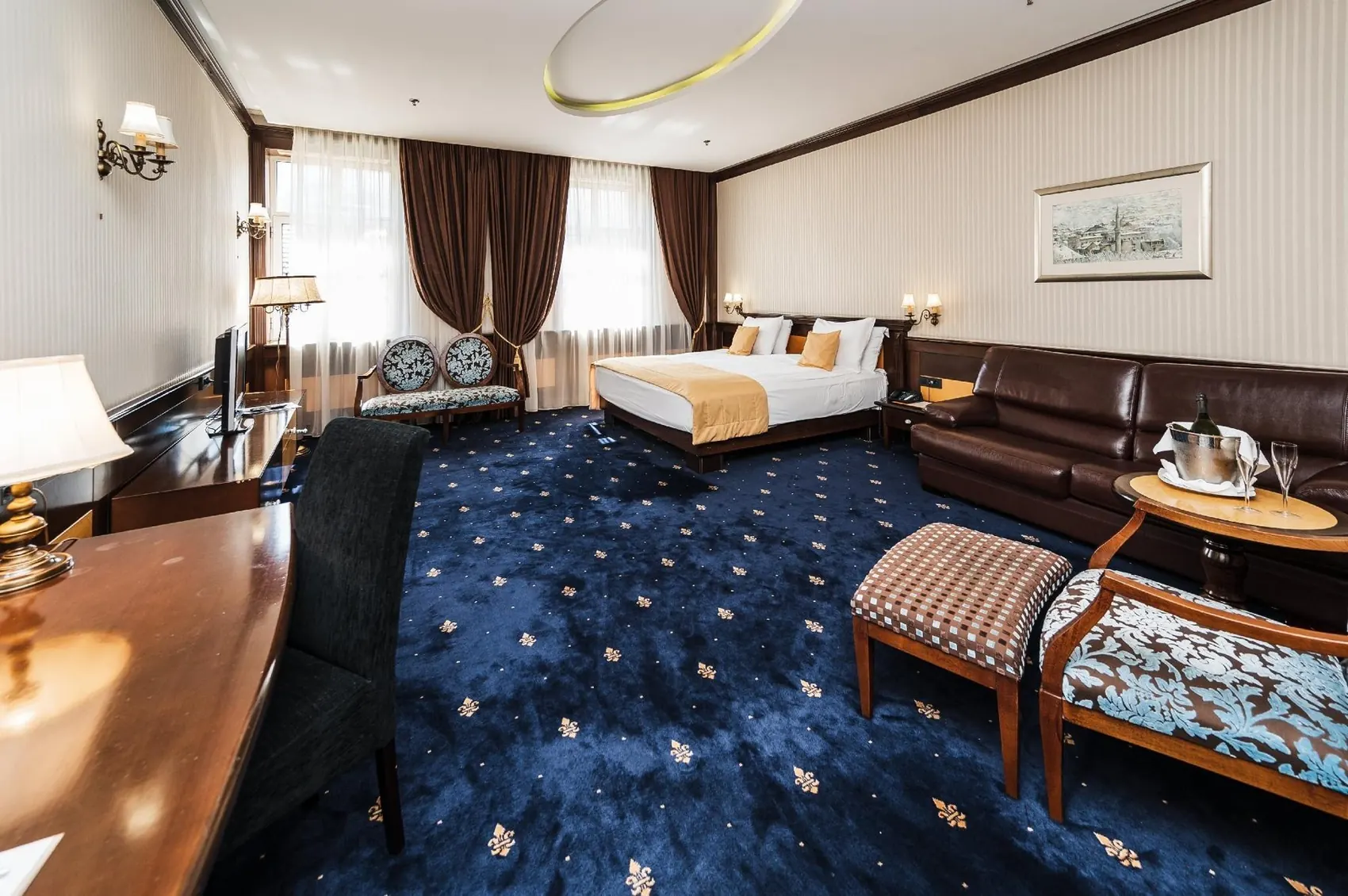
Današnji izgled apartmana u starom kriluA suite in the old wing, today
Kad je u Sarajevo dolazio neko iz carske kuće ili s evropskog prijestolja, novine su unaprijed znale gdje će spavati.Whenever someone from the imperial house or a European throne came to Sarajevo, the papers knew in advance where they would sleep.
U oktobru 1898. nadvojvoda Rainer stigao je iz Travnika. Kako je zabilježio Sarajevski list, sa stanice se odvezao u hotel Evropa. Uprkos kiši dočekalo ga je mnoštvo ljudi, a s crkava su se čula zvona. Večer je proveo u svojim hotelskim odajama. U hotelu je prenoćila i njegova svita.
In October 1898 Archduke Rainer arrived from Travnik. According to the Sarajevski list, he drove from the station to the Hotel Europe, where despite the rain a crowd greeted him while church bells rang. He spent the evening in his rooms at the hotel, where his entire entourage also stayed.
U Evropi su odsjedali i vjerski poglavari kad su dolazili u glavni grad: mitropolit Petar Zimonjić iz Mostara 1910. godine i mitropolit Ilarion Radonić iz Tuzle godinu kasnije. Novi komandant sarajevske tvrđave proveo je 1912. godine prve noći svog boravka u gradu upravo u tom hotelu.
Religious leaders also stayed at the Evropa when they came to the capital: Metropolitan Petar Zimonjić from Mostar in 1910, Metropolitan Ilarion Radonić from Tuzla in 1911. In 1912 the new commander of the Sarajevo fortress spent his first nights at the hotel.
Kralj koji je kasnio na ručakThe king who was late for lunch
Na povratku s Cetinja u augustu 1910. bugarski kralj Ferdinand i prijestolonasljednik Boris nenajavljeno su posjetili Sarajevo. Program je predviđao ručak u Evropi poslije jedanaest sati, ali se kralj zadržao u kupovini. Obišao je umjetničke radionice, knjižaru Alberta Thiera i radnju Kabiljo. Kad je napokon stigao, za stolom ga je čekalo šesnaest zvanica, među njima i strani konzuli. Ručak je trajao jedva četrdeset minuta, a kralj je, piše Bosnische Post, pohvalio kako je ručak priređen i kako se dobro jede u hotelu.
In August 1910, returning from Cetinje, King Ferdinand of Bulgaria made an unannounced visit to Sarajevo with Crown Prince Boris. The programme had lunch at the Evropa shortly after eleven, but the king lingered over his shopping in the craft workshops, Albert Thier’s bookshop and the Kabiljo store. When he finally arrived, sixteen guests were waiting at the table, foreign consuls among them. Lunch lasted barely forty minutes, and the king, wrote the Bosnische Post, praised the arrangements and the hotel’s good cooking.
Mladi parThe young couple
Krajem novembra 1911. u Evropi su odsjeli nadvojvoda Karlo Franjo Josip i nadvojvotkinja Zita, mjesec dana poslije vjenčanja. Obišli su Begovu džamiju, Sabornu crkvu, Čaršiju, Svrzinu kuću i Vijećnicu. Nakon ručka nadvojvoda je posebno pohvalio hotel i bosanski salon koji je opremila firma Elias B. Kabiljo. Pet godina kasnije Karlo i Zita postali su car i carica.
In late November 1911 Archduke Karl Franz Joseph and Archduchess Zita stayed at the Evropa, a month after their wedding. They visited the Bey’s Mosque, the Orthodox Cathedral, the bazaar, the Svrzo House and the City Hall, and after lunch the archduke expressed great satisfaction with the hotel and with the Bosnian salon furnished by the firm of Elias B. Kabiljo. Five years later the same couple were emperor and empress.
Prema izvještaju lista Sarajevoer Tagblatt od 11. maja 1912, hotel je pripremio tri apartmana za devetnaestogodišnjeg saksonskog prijestolonasljednika Georga i dva za njegovu pratnju. Georg je putovao pod drugim imenom.
On 11 May 1912 the Sarajevoer Tagblatt reported that the hotel had set aside three suites for Georg, the nineteen-year-old crown prince of Saxony, and two for his party. He was travelling under an assumed name.
Samo u proljeće i ljeto 1911. u knjigu gostiju upisali su se knez Franz Auersperg, grof Clam-Martinitz, barun de Neufville iz Pariza i grofica Elisabeth Dubsky, rođena Kinsky. U junu je iz Dubrovnika stigao egipatski princ Ibrahim Ratib s damama, ličnim ljekarom i poslugom. Dva mjeseca kasnije vratio se s porodicom u isti hotel. U julu je automobilom došao američki novinski magnat William Randolph Hearst, a u augustu je u prolazu ovdje noćio mladoturski vođa Enver-beg, budući Enver-paša.
In the spring and summer of 1911 alone, the guest book was signed by Prince Franz Auersperg, Count Clam-Martinitz, Baron de Neufville from Paris and Countess Elisabeth Dubsky, née Kinsky. In June the Egyptian prince Ibrahim Ratib arrived from Dubrovnik with ladies, a personal physician and servants, and two months later he came back with his family, to the same hotel. In July the American newspaper magnate William Randolph Hearst drove up by car, and in August the Young Turk leader Enver Bey, the future Enver Pasha, stayed a night on his way through.
U septembru iste godine u Sarajevo je stiglo sto trideset francuskih putnika. Do Gruža su doputovali posebnim parobrodom, a odatle posebnim vozom. Među putnicima su bili umjetnici, pisci, arhitekti, pedeset dama i sin bivšeg predsjednika Republike Loubeta. Odsjeli su i ručali u hotelima Evropa i Central. Novine su objavljivale spiskove pristiglih gostiju po hotelima, a u rubrici za Evropu redala su se imena iz Beča, Pešte, Praga, Kopenhagena, Soluna i New Yorka.
In September of that year a hundred and thirty French travellers arrived by special steamer at Gruž and then by special train: artists, writers, architects, fifty ladies and the son of the former President of the Republic, Émile Loubet. They were lodged at the Hotels Europe and Central, where they also took lunch. The papers published lists of new arrivals hotel by hotel, and under the Evropa came names from Vienna, Pest, Prague, Copenhagen, Salonica and New York.
InkognitoIncognito
Nisu svi gosti htjeli da se zna ko su. U julu 1909. kroz Sarajevo je prošao strani oficir o kojem ništa nisu znale ni policija ni komanda mjesta, a Sarajevoer Tagblatt požalio se da čak ni od portira Evrope, u kojoj je oficir odsjeo, nije mogao saznati kako se gost zove ni kojem rodu vojske pripada. Tek se navečer saznalo da je riječ o majoru Russellu, britanskom vojnom atašeu u Beču.
Not every guest wished to be known. In July 1909 a foreign officer passed through Sarajevo about whom neither the police nor the garrison command knew anything, and the Sarajevoer Tagblatt complained that it could learn neither the officer’s name nor his branch of service, even from the porter of the Hotel Europe, where he was staying. Only in the evening did it emerge that he was Major Russell, the British military attaché in Vienna.
Tabla XPlate X
Zlatna knjigaThe Golden Book